

 Centric PLM
 Centric Planning
 Centric Pricing & Inventory
 Centric Market Intelligence
 Centric Visual Boards
 Centric PXM
 Experience Academy


 Fashion & Apparel
 Retail
 Footwear
 Outdoor & Sports
 Consumer Goods
 Manufacturers
 Home Décor & Furniture
 Food and Beverage
 Grocery Retail
 Cosmetics & Personal Care
 Consumer Electronics









What Is Data Feed Management?

Data feed management refers to the end-to-end process of transforming raw product data into channel-ready content for e-commerce and marketing platforms. It includes formatting, enriching and delivering accurate, up-to-date information that aligns with each platform’s unique structure and requirements.
Effective shopping data feed management improves product visibility, reduces listing errors and enables consistent shopping experiences across digital channels. As brands grow across platforms, efficient feed management becomes essential for scalability and revenue growth.
This guide is designed for brands, retailers and e-commerce teams, especially digital marketers, merchandisers and content operations leads, looking to streamline workflows and optimize product content performance.
Understanding data feed management
Data feed management, also known as product feed management or shopping feed management, is the process of preparing and distributing structured product information to external platforms. This includes meeting the technical and content requirements of each channel, from online marketplaces and search engines to social commerce platforms and affiliate networks.
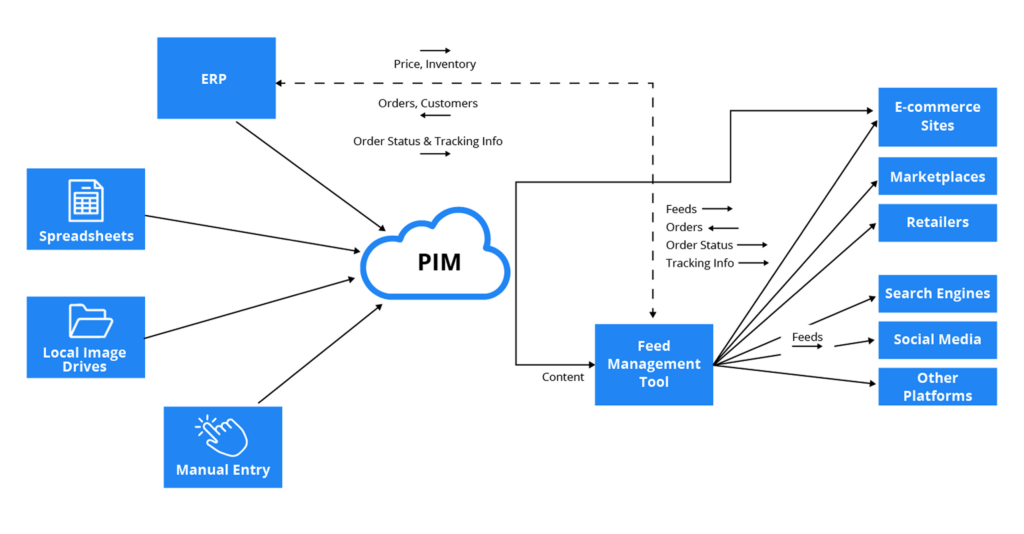
At the core of this process is the product data feed: a structured file containing detailed information about a brand’s catalog. A typical feed includes attributes such as product titles, descriptions, pricing, inventory levels, images, sizes, colors, SKUs and identifiers like GTIN or UPC codes. Feeds are typically formatted as CSV, XML or JSON files.
A well-managed data feed acts as a dynamic bridge between e-commerce systems and external sales environments. When product data is clean, complete and optimized, channels can correctly interpret it, reducing listing errors and improving time-to-shelf.
Why data feed management matters?
Listing the same product across multiple platforms may seem straightforward until each one demands a different title format, description length, image ratio or set of required attributes.
For example, a pair of shoes submitted to Google Shopping, Amazon and Meta must meet three different sets of criteria before appearing in search results. Without proper feed management, products risk being rejected, overlooked or inaccurately displayed, leading to lost sales and poor customer experience.
Effective product data feed management enables:
- Higher product visibility and sales performance across key channels through optimized, platform-specific content
- Multichannel and omnichannel consistency, ensuring shoppers see accurate, relevant product data no matter where they browse. Fewer data errors and overselling issues through real-time synchronization and validation across systems
- Seamless scaling into marketplaces, social commerce platforms and shopping ad networks without manual rework or delays
Here’s a quick look at what some top platforms require from product feeds:
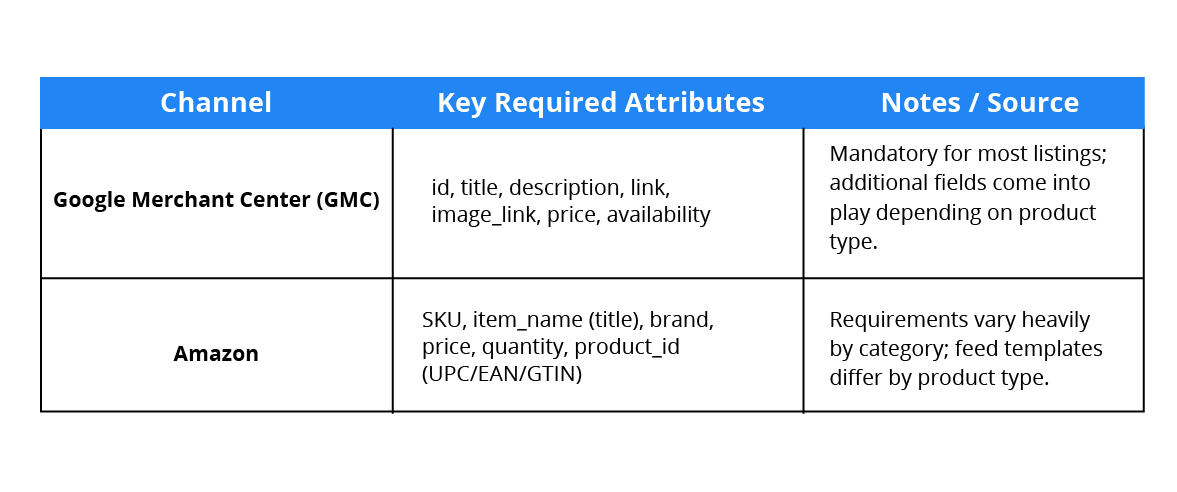
This variety makes scalable data feed management mission-critical for digital commerce.
Key components of data feed management
Effective data feed management depends on several foundational elements that ensure products are accurately represented across every channel. Each component plays a critical role in maximizing visibility, maintaining data integrity and driving higher marketplace performance.
Feed quality
Product data must be complete, accurate and optimized to meet platform algorithms and shopper expectations. This includes enhancing titles and descriptions, filling in key attributes like color, size and GTIN and ensuring consistent formatting throughout the feed.
Source quality
Feed output is only as good as the input. Reliable, up-to-date data from e-commerce platforms or back-end systems, like current pricing, high-resolution images and accurate stock levels are essential for maintaining trust and reducing listing errors.
Channel requirements
Each platform (Google Shopping, Amazon, Meta and others) enforces its own data standards. Adapting product content to fit these specifications is critical to ensure acceptance and performance.
Synchronization
Timely updates prevent overselling, pricing mismatches and stock issues. Automated, scheduled feed refreshes help keep listings current across all platforms and reflect real-time changes in product availability or promotions.
How data feed management works
Data feed management turns raw product information into optimized, channel-ready listings through three core steps:
1. Data collection
Product data is pulled from a centralized source, typically an e-commerce platform, ERP, PIM or spreadsheet. This raw data includes key attributes like product names, descriptions, prices, inventory levels and images.
2. Feed optimization
The data is cleaned, enriched and formatted using feed rules. This includes optimizing titles and descriptions, filling in missing fields, applying custom labels and aligning with the specific requirements of each target channel (e.g., Google Shopping, Amazon, Meta).
3. Channel synchronization
Once optimized, the feed is exported in the correct format (CSV, XML, JSON) and distributed to each platform. This step may include real-time updates, automated scheduling and API-based integrations to ensure listings stay accurate and up to date across all endpoints.
Channels that rely on data feeds
A wide range of digital commerce and advertising platforms rely on accurate product feeds:
Marketplaces
Platforms like Amazon, Walmart and eBay require detailed, structured product feeds to list items in their vast catalogs. Accurate data is essential to avoid rejections, reduce return rates and stay competitive in search rankings.
Search engines
Google Shopping and Microsoft Ads use product feeds to generate dynamic shopping ads that surface based on search intent. Feed quality directly influences visibility, click-through rates and ad performance.
Social platforms
Facebook, Instagram and TikTok Shops rely on product feeds to populate in-app storefronts and power native shopping experiences. These channels often require image-heavy, mobile-optimized content with localized descriptions and pricing.
Affiliate networks and AI engines
Platforms like Rakuten, ChatGPT and Perplexity use product feeds to fuel recommendation engines, comparison tools and conversational shopping experiences. Clean, structured data increases discoverability and reach across emerging retail touchpoints.
Challenges in feed management
Managing product feeds across multiple platforms introduces a range of operational and technical challenges. Without the right structure and automation in place, teams can quickly become overwhelmed by the volume and variability of requirements.
- Data formatting inconsistencies – Product data from multiple sources often lacks consistency, with missing fields or mismatched formats that must be corrected before channel submission.
- Channel-specific listing rejections – Each platform has strict formatting and content rules. Minor issues like missing IDs or overlong titles can result in listing delays or rejections.
- Inventory sync issues – Without real-time updates, pricing and stock data can become outdated, leading to overselling, stockouts or customer dissatisfaction.
- Resource bottlenecks and scaling – As channels and SKUs grow, manual processes slow execution and cause operational strain without automation.
Data feed management solutions, tools and strategies
Many brands rely on purpose-built tools and systems to streamline and scale feed operations. These solutions help automate processes, enforce data quality and ensure channel compliance.
Feed management platforms
These platforms provide rule-based optimization, real-time syncing and built-in channel templates to simplify feed creation and distribution across hundreds of platforms.
PIM integration advantages
Combining feed management with a Product Information Management (PIM) like Centric PIM™ ensures a single source of truth for product data. Centralized data makes it easier to enrich, validate and syndicate content across multiple touchpoints while maintaining consistency.
Centralized vs. decentralized approaches
A centralized strategy consolidates product content, feed logic and governance in one platform. A decentralized model, while more flexible for local teams, can lead to duplicate work, data fragmentation and inconsistent channel performance.
Best practices for optimizing data feeds
The following best practices help ensure product data is not only accepted by each platform but also performs at scale.
- Structure titles and descriptions for performance – Prioritize key details like brand, product type, size and variant early in the title. Use clear, keyword-rich descriptions that align with shopper intent and platform SEO guidelines.
- Apply feed rules and custom labels – Use dynamic rules to automate enhancements, fix common issues and segment products by attributes such as margin, seasonality or availability. Custom labels enable smarter campaign targeting and reporting.
- Use data governance to prevent sync issues – Maintain data quality at the source with validation rules, standardized attribute naming and controlled workflows. This prevents errors before they reach downstream feeds.
- Enable real-time updates and two-way order sync – Keep listings accurate with frequent or real-time updates for inventory and pricing. Integrating two-way order sync ensures stock levels reflect actual sales, reducing the risk of overselling or fulfillment delays.
Feed optimization at work: Real outcomes
Two leading brands unlocked major efficiency gains by leveraging Centric PXM’s AI-powered syndication engine that streamlines product data feeds, automates channel delivery and supports scalable product experience management.
Mob-in scaled across new countries and marketplaces while reducing the manual workload tied to product content and listings.
Result: 50% reduction in time to launch new marketplaces.
Before Centric, creating a new marketplace in a new country took 3 days. With Centric, it takes us 1½ days. That’s 50% faster.” - Mariane Thorrez, Marketplace Manager at Mob-In
Aetrex unified product data and streamlined channel syndication, resulting in significant growth across key marketplaces.
Result: Faster time-to-market and stronger marketplace performance.
We’ve had 400% growth from marketplaces since using Centric PXM and 10x more revenue from Amazon alone on a daily basis.” - Rui Kojima, Senior Director of e-Commerce at Aetrex
Scaling product feeds: When to invest and why it matters
The tipping point for adopting a dedicated feed management solution often arrives as product complexity, sales channel count and content volume increase. Manual workflows become unsustainable and performance begins to suffer without structured automation.
Signs the business is ready for a dedicated feed management solution
- Expanding product catalog with high SKU volume
- Active presence across multiple sales or ad channels
- Frequent product updates (pricing, inventory, content)
- Limited internal bandwidth to manage listings manually
- Recurrent errors, listing rejections or inconsistent product data
Key questions when evaluating solutions
- Does the platform support all current and planned channels?
- Can it integrate with existing systems (PIM, ERP, ecommerce)?
- How does it handle data validation, automation and error resolution?
- What level of onboarding, training and support is included?
- Is the platform flexible enough to accommodate future scaling?
In-house vs. outsourcing models
Choose based on internal capacity, expertise and strategic goals:
In-house management
- Strong internal technical team in place
- Desire for full control and customization
- Willingness to maintain and evolve the system over time
Outsourced or managed service
- Need for speed, expertise and proven workflows
- Limited internal resources or feed management knowledge
- Focused on results, with less emphasis on hands-on control
The role of data feed management in omnichannel strategy
Consistency is non-negotiable for shoppers who expect accurate, real-time product content wherever they browse. Data feed management enables the consistency necessary for seamless omnichannel experiences.
When integrated into a broader lifecycle ecosystem, feed management plays a critical role in a closed-loop product experience strategy, connecting upstream product data with downstream channel execution and continuous performance feedback.
Centric Software’s closed-loop approach, powered by its Product Experience Management (PXM) capabilities, unites product data management, channel syndication, customer feedback and ongoing optimization into one seamless cycle. This ensures product content is not only accurate and consistent but also adaptable and supports in closing the loop between what’s developed, what’s sold and how it performs in-market.
Feed management becomes more than operational. It becomes strategic, supporting agile content delivery and a unified product experience across the full commerce ecosystem.
Powering growth through smarter product feeds
Data feed management sits at the intersection of content, commerce and customer experience. When product content is optimized across every channel, brands unlock visibility, trust and measurable growth.
Achieving omnichannel consistency starts upstream with strong product data foundations. Centric PLM™ plays a critical role in centralizing and standardizing product information at the source. When this structured data flows into Centric PXM™, brands gain a connected, closed-loop system that links product development with real-time channel execution and ongoing optimization.
Together, these capabilities form a unified product experience ecosystem that accelerates speed-to-market, improves accuracy and fuels stronger performance across every digital touchpoint.
As commerce becomes more complex, brands that integrate product lifecycle management with feed strategy are better equipped to scale and adapt. Feed optimization becomes a growth driver and with Centric PXM, it becomes a connected advantage.