From European Regulation to North American Reality: The DPP Readiness Question
For North American fashion and apparel brands, Digital Product Passports (DPP) have been relatively easy to categorize as a future European requirement.
But that future is starting to take shape.
In July 2026, the European Commission launched the Digital Product Passport Registry, putting a key piece of the technical infrastructure behind DPP into operation. The Registry provides the framework for registering DPPs and their unique product identifiers, while new technical standards establish how businesses will identify, exchange and access product information.
For apparel, the requirements themselves are still being developed. The European Commission currently plans to adopt the ESPR delegated act for textiles in late 2027, with additional guidance and implementation measures to follow.
Requirements are still evolving, but DPP is becoming increasingly tangible.
For North American brands, that raises a more immediate question: How prepared is the organization to produce trusted product data when transparency requirements reach the business?
The issue isn’t compliance, it’s proving it
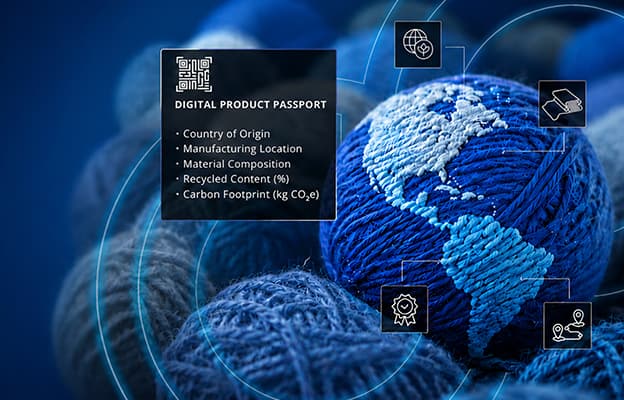
Digital Product Passports are often associated with their most visible element: a QR code or other digital identifier that provides access to information about a product.
But the identifier is only the delivery mechanism. The information behind it has to come from somewhere.
Material composition, supplier information, sustainability attributes, product specifications and compliance documentation develop throughout the product lifecycle. Different teams create and update that information at different stages, often using different systems and processes.
For DPP, the existence of that information is only part of the equation. Organizations also need confidence that the underlying product data is accurate, complete and up to date.
That distinction becomes particularly important as the DPP framework moves toward implementation. Economic operators placing covered products on the EU market will be responsible for making the required DPP available, while suppliers and other partners may provide information that feeds into it.
The data may exist across the organization and supply chain. Proving it is another matter.
Product transparency starts long before the QR code
Consider what happens during the development of a single apparel product.
Teams select and change materials. Suppliers provide information and documentation. Specifications evolve. Sustainability and compliance attributes enter the process. Different versions of the product move through development before the final version reaches production.
By the time someone asks for product-level transparency, much of the relevant information has already passed through multiple hands. Trying to reconstruct that history at the end creates a very different challenge from governing the information as teams create it.
This is why DPP readiness increasingly points upstream, toward the systems and processes brands use to manage information throughout product development.
A governed product record, material and component traceability, product-level data, version control and shared visibility across functions all create a stronger foundation for transparency.
The QR code may be where the consumer, retailer or regulator encounters the information. Product development is where much of its credibility begins.
The infrastructure is becoming real
Until recently, it was relatively easy to view DPP as a regulatory framework whose practical implementation remained somewhere in the future. That’s changing.
With the DPP Registry operational and technical standards taking shape, businesses now have a clearer view of the infrastructure that will underpin product-level transparency.
The Registry will act as an indexing service for DPPs. Before a covered product is placed on the EU market, the relevant economic operator will eventually need to register its DPP in accordance with the legislation applicable to that product category.
Apparel is not at that stage yet. The forthcoming textile delegated act will establish its exact requirements.
But the distinction matters: DPP is moving from policy design toward operational infrastructure.
For brands waiting for evidence that Digital Product Passports will become a practical business requirement, that evidence is becoming considerably harder to ignore.
Waiting for final rules creates its own risk
Uncertainty still exists, particularly for apparel.
The exact information required in a textile DPP has not been finalized. The European Commission currently indicates that it may include product identification, fiber composition, information supporting repair and maintenance, end-of-life and recycling information, origin and identification of relevant economic operators.
With those details still under development, waiting for final requirements may appear to be the safest approach.
But regulatory clarity and operational readiness run on different timelines.
Product data cleanup and supplier collaboration take time. Governance decisions require agreement across product development, sourcing, compliance, sustainability and IT. Changes to systems and processes compete with other organizational priorities and budget cycles.
The objective today isn’t to predict every field that will eventually appear in a Digital Product Passport. It’s to determine whether the organization has the product data foundation to respond when those requirements become clear.
North American brands already have a reason to think ahead
Some brands are already approaching product data with future transparency requirements in mind.
Outdoor apparel brand Stio, for example, has used Centric PLM™ to centralize product information while navigating initiatives including its transition away from PFAS and preparations for Digital Product Passport requirements.
The significance goes beyond one regulation.
Building stronger control over materials, suppliers, specifications and product information gives organizations a foundation they can use as transparency expectations evolve.
That matters for regulatory compliance, but it also matters when a retailer requests deeper product documentation, a new market introduces different requirements or customers expect greater visibility into the products they buy. Forward-looking product data practices create options.
Market access changes the conversation
For North American brands, the most useful question may not be, “When do we have to comply with DPP?” A better set of questions is broader.
Where does the business have exposure to European markets today? Where does it expect to grow? How quickly are teams able to compile complete, verified product information if a retailer or regulator requested it?
Those questions reveal more than DPP readiness.
They show how prepared the organization is for a market in which product transparency increasingly travels across borders, retailer relationships and supply chains.
The launch of the DPP Registry adds another dimension. The technical infrastructure for registering and exchanging product information is no longer hypothetical. For textiles and apparel, category-specific requirements are still ahead, but the broader system they will eventually enter is taking shape now.
Digital Product Passports may have emerged from European regulation, but the capabilities behind them are becoming relevant well beyond Europe.
For North American fashion and apparel brands, preparing early isn’t simply about satisfying a future compliance requirement. It’s about maintaining control over product data as transparency becomes increasingly important to global market access.
Explore what DPP means for product data management, the assumptions that create a false sense of readiness and five practical steps brands can take now to prepare.